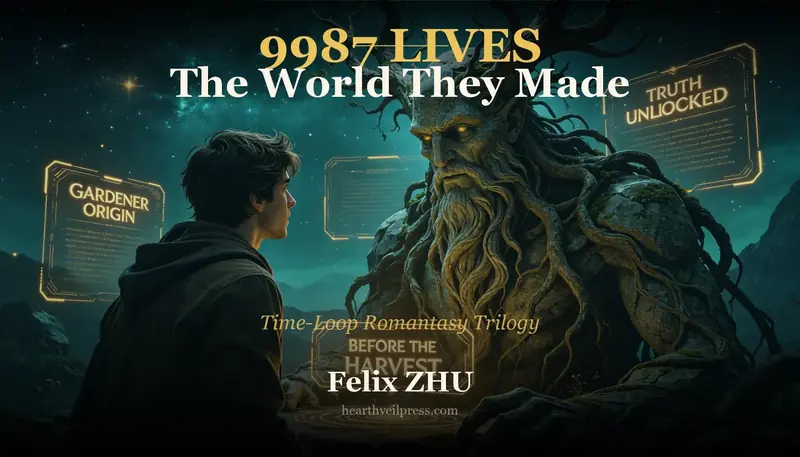
The loop is broken. The silence after is theirs to fill.
The system is gone. The numbers are gone. The countdown has stopped. The corruption is zero. The harvest is over. But the silence after — that's the hardest part. Lyra has lost her memories. Felix has lost his power. Together, they have to learn what it means to be ordinary.
A time-loop romance that isn't about winning a war. It's about learning to stay.
From a trembling charcoal sketch on a cell wall in Book One to a golden bird flying over the ocean in Book Three. The trilogy's central image, completed.
Lyra loses the details of 9,987 cycles but keeps the feeling. The book asks: if you don't remember why you love someone, is the love still real?
No final battle. No world-shaking spell. The climax is planting tomatoes, building a porch, raising a child. The hardest victory to write — and the most honest.
"I want to go home. Not to the divine realm. Not to the machine. To this world. In trees. In oceans. In birds." The shadow doesn't die. It disperses.
The antagonist isn't killed off. He is given a choice — and the trilogy's core value (choice over destruction) is applied even to him.
The final image. Two old people on a porch, watching a golden bird fly over the ocean. No system. No countdown. Just a life that was earned.
Book Three does something rare in fantasy: it takes the aftermath seriously. The system terminates in Chapter 71. Nine chapters remain. Nine chapters of what happens after — when there is no countdown, no corruption percentage, no trust score measuring whether you are loved enough.
Lyra has lost the details of 9,987 cycles. She remembers the feeling of loving Felix but not the specific moments. Felix has lost the shadow — the power that defined him, the thing that made him a monster and a harvest. Together, they have to learn what ordinary people do: plant a garden, build a house, raise a child, sit on a porch and watch the sun set.
This is the volume that has made readers cry the most. Not because of a death or a betrayal, but because of the honesty of it. The loop is broken, but the trauma doesn't disappear. The memories don't come back. They have to build something new from what remains — and the book argues that this is not a consolation prize. It is the point.
Readers who finished Books One and Two and need to know how it ends
Anyone who believes the best fantasy endings are about people, not battles
Fans of bittersweet, earned conclusions that stay with you
Readers who want a trilogy that actually sticks the landing
It has an honest ending. Not perfectly happy, not tragic. Bittersweet and earned. The loop is broken. The characters live. But loss is real, and the book doesn't pretend otherwise.
The system terminates in Chapter 71. The remaining nine chapters have zero system panels, zero numbers, zero countdowns. This is intentional — the absence of the system is the point.
With a porch, a garden, a child, and a golden bird flying over the ocean. No final battle. No world-shaking magic. Just two people who earned the right to be ordinary.
The trilogy is complete. The story has a clear ending. Any future work would be a separate story in the same world, not a continuation of Lyra and Felix's arc.
She remembered everything. Even the endings. This time, she's not running.
Secure checkout · Instant delivery · EPUB format
Join the Hearth Veil Press newsletter for free sample chapters, writing updates, and exclusive deals.
No spam. Unsubscribe anytime. GDPR compliant.